
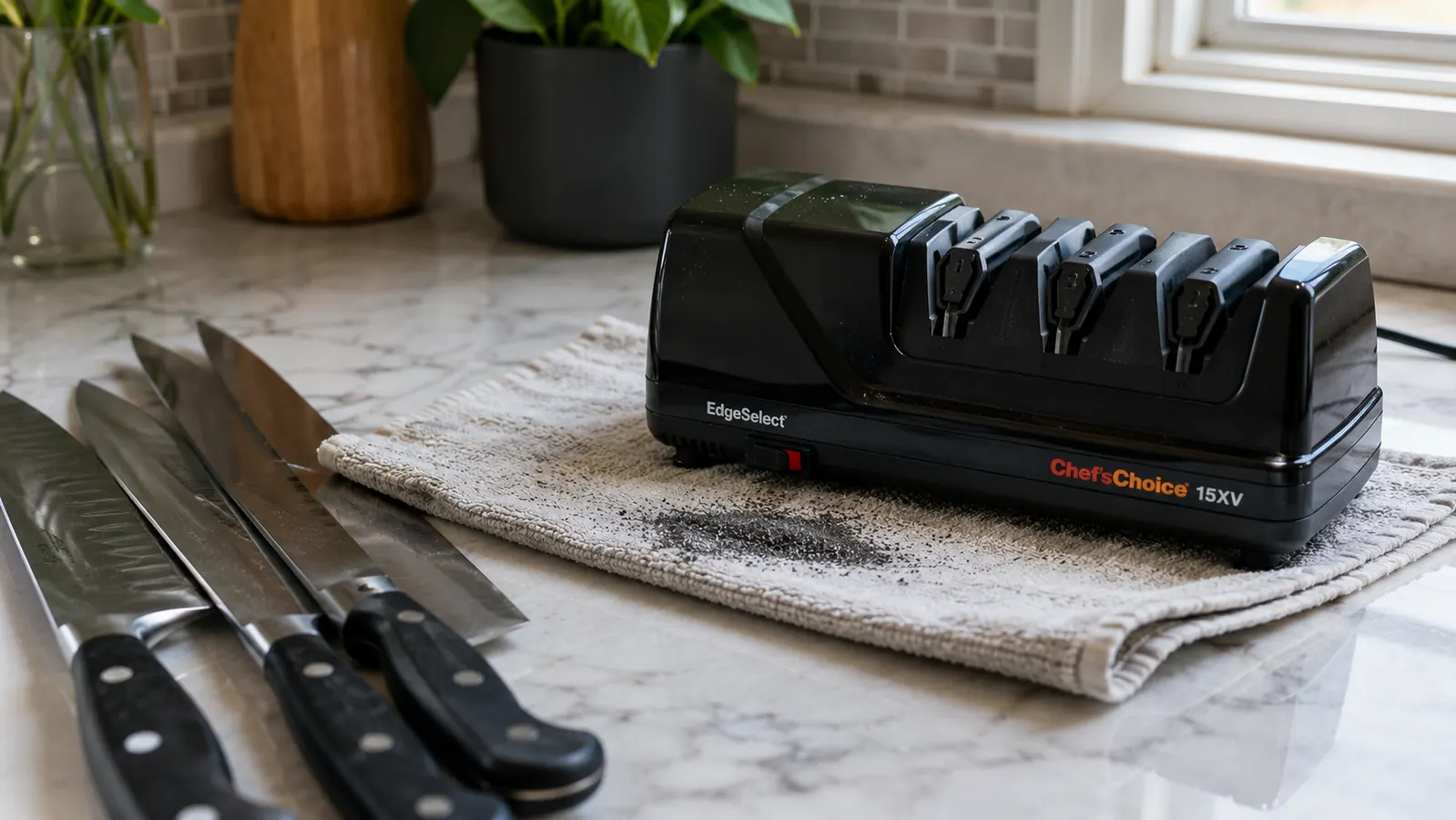
Every Chef'sChoice review online reads the same way: a shiny before-and-after photo of a knife slicing paper, five stars, done. I bought the Chef'sChoice 15XV EdgeSelect eight months ago after my neighbor wouldn't stop talking about hers, and the first thing I noticed wasn't the sharpness. It was the fine gray dust drifting off my counter onto the floor mat after my very first sharpening session, something not one of those glowing reviews had bothered to mention. Twenty years of testing kitchen gadgets for a living taught me that the stuff nobody complains about publicly is usually the stuff that decides whether you keep using something past week three or shove it in a drawer.
This isn't a takedown. The 15XV does sharpen knives, and it does it well once you know what you're doing. But I've spent eight months running every knife I own, plus two borrowed from a friend who wanted a second opinion, through this machine, and I've collected a list of small annoyances and a couple of real mistakes that the marketing photos and the influencer unboxings never show you. Consider this the review that fills in the gaps between the box and your actual counter.
The Quick Verdict
A capable diamond-wheel sharpener with real friction points around mess, noise, and a blind spot for wide blades that the polished reviews conveniently leave out.
Amazon Check Today's Price →Before you buy based on the five-star photos, read what they leave out
The Chef'sChoice 15XV EdgeSelect genuinely sharpens knives with a consistent 20-degree angle. It's also messier and less plug-and-play than most reviews admit. Check today's price and decide with the full picture.
Amazon Check Today's Price on Amazon →How I Tested It
I didn't just run one knife through it and call it a review. Over eight months I put nine blades through the 15XV: an 8-inch Henckels chef's knife with a thick bolster, a lighter Global santoku, a Victorinox serrated bread knife, a paring knife, a set of off-brand steak knives I keep for guests, a boning knife with a curved belly, and two knives a friend dropped off out of curiosity, including a ceramic paring knife I'll get to shortly because it taught me something the box should have said outright.
My testing routine was simple and repeated: dull each knife naturally through normal weeknight use, run it through the appropriate stages, then check the edge against a folded sheet of printer paper and a ripe tomato, the same two tests I've used to judge blade sharpness for two decades. I logged the time each session took, whether the edge came out even on both sides, and how much cleanup the machine demanded afterward, because cleanup turned out to be a bigger factor in whether I actually reached for this thing than I expected going in.
What follows isn't a spec sheet. It's the running list of things that surprised me, most of them things I had to figure out myself because neither the included instructions nor the reviews I'd read before buying mentioned them.
I also timed cleanup separately from sharpening, because that's the part most reviews skip entirely. Wiping the counter, brushing out the slots, and shaking out the towel added another two to three minutes per session in the early weeks, dropping to under a minute once I built the habit of doing it every time instead of letting filings pile up over several sessions. That number matters more than it sounds like it should, because it's the difference between a gadget you reach for on a busy Tuesday and one that quietly migrates to the back of a cabinet.
The Mess Nobody Warns You About
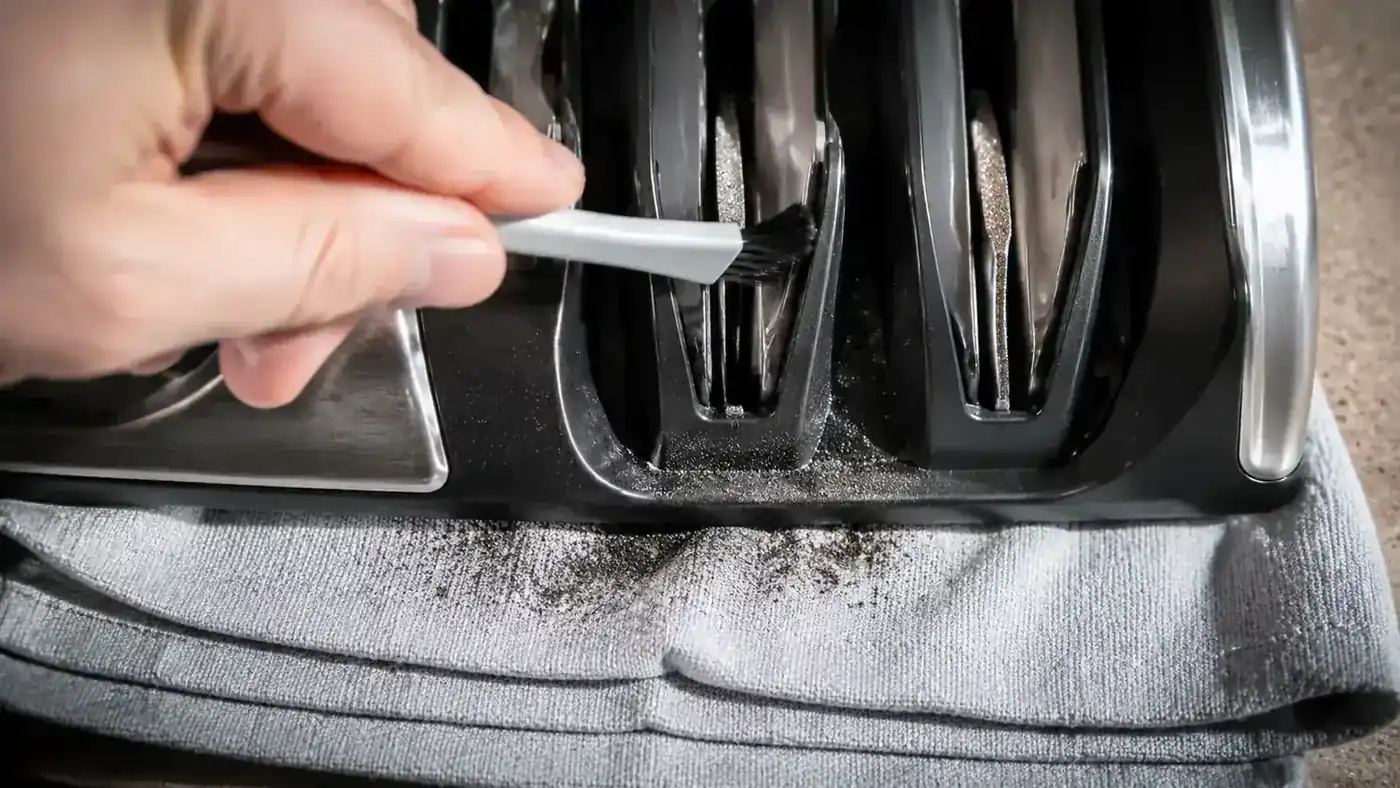
The diamond wheels shed fine metal filings, and Stage 1 in particular throws off enough gray dust that I now sharpen exclusively over a folded kitchen towel that I shake out over the trash afterward, not near my sink or anywhere close to produce. Nobody told me this before I bought it. I found out the hard way when I ran my first knife through on my bare countertop and later found grit under my palm when I leaned on the spot to roll out dough.
There's a faint hot-metal smell during an aggressive Stage 1 pass on a genuinely dull blade, not unpleasant exactly, but noticeable enough that I crack a window if I'm doing more than one or two knives in a sitting. And the abrasive slots themselves fill with filings faster than I expected, meaning the little cleaning brush that ships in the box isn't a nice-to-have accessory, it's something I use after almost every session or the next sharpening pass feels gritty and inconsistent instead of clean.
None of this is a dealbreaker. It's a fifteen-second wipe-down most days. But if you're picturing a tidy countertop appliance you can run and walk away from, adjust that expectation now, because this machine leaves a trace every time you use it, and the box photos never show that part.
The Angle Guide Has a Blind Spot for Wide Blades
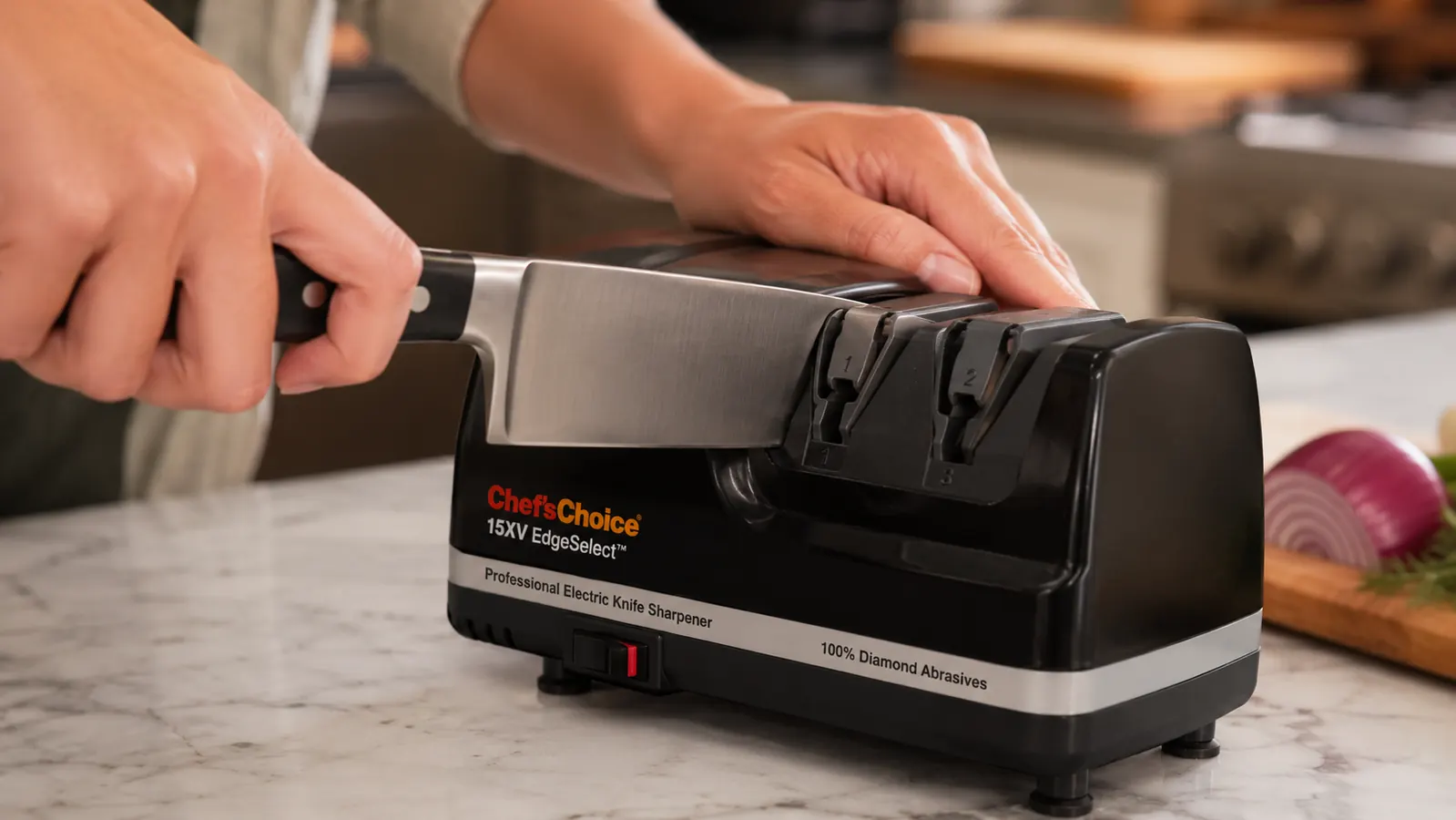
My Henckels chef's knife has a thick bolster, the metal collar where the blade meets the handle, and it does not sit flush in the Stage 1 slot the way my slimmer Global santoku does. The heel of the blade near the bolster catches slightly, which means I have to apply a bit of extra downward pressure right at that spot to keep the whole edge tracking through the guide evenly. Skip that adjustment and you end up with a heel that's noticeably less sharp than the rest of the blade, something I only caught because I test the whole edge length against paper, not just the middle third most people check.
The curved boning knife gave me a similar headache from a different angle. Its belly curves more sharply than a standard chef's knife, and pulling it through the slot at a consistent speed took real practice, because the geometry of the guide assumes a fairly straight edge profile. I got it working, but it took four or five attempts before the curved section came out as sharp as the straight part near the handle, and that's four or five attempts more than the instructions implied it would take.
None of the reviews I read before buying mentioned bolster clearance or curved-belly knives at all. If your knife block is mostly slim, straight-edged blades, you may never notice this. If you've got a heavy German-style chef's knife with a substantial bolster, budget extra time and extra passes for the heel, because the guide wasn't designed with that shape as the default.
It's Louder and Slower Than the Marketing Suggests
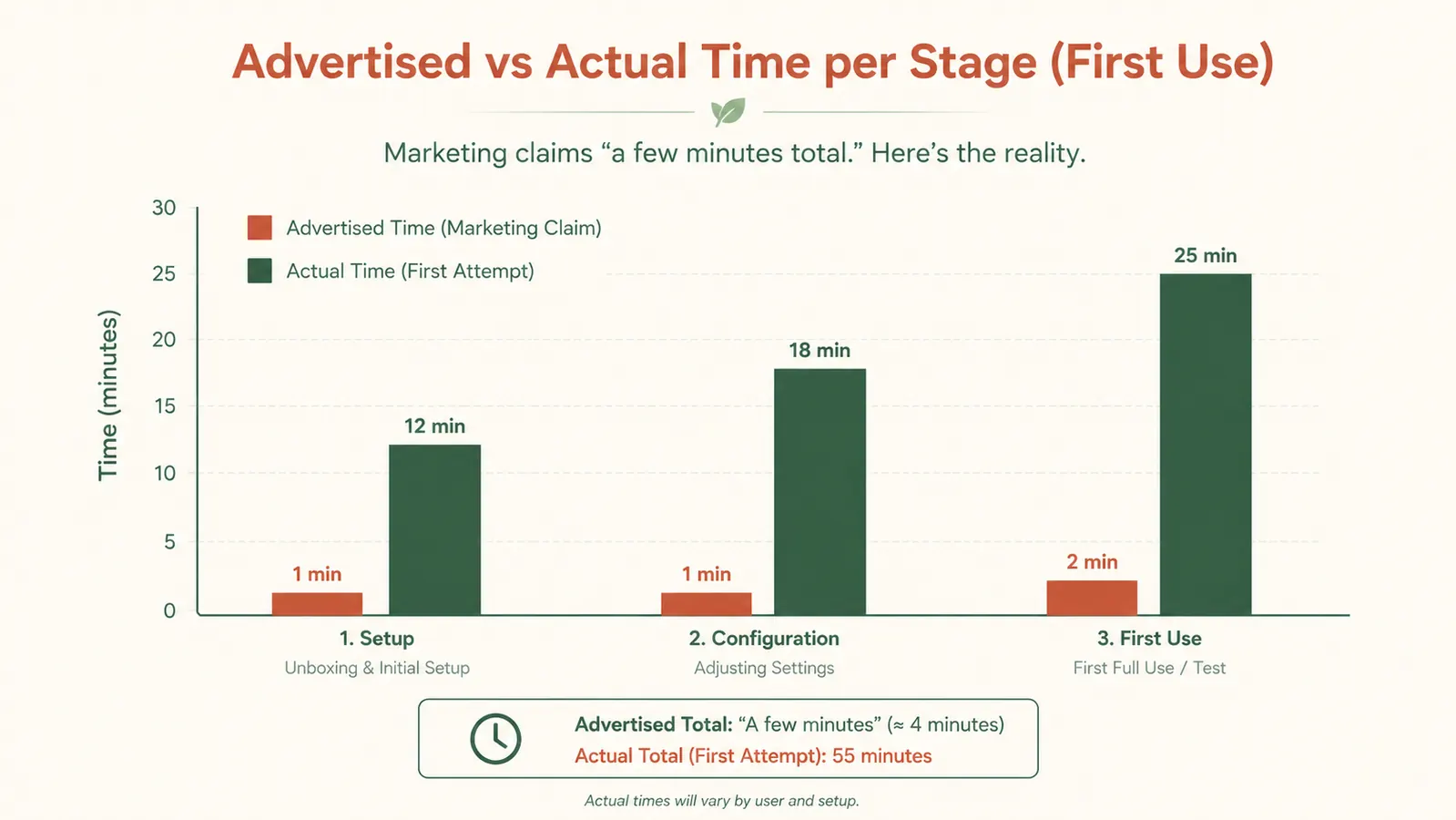
The listing photos and the box copy both imply a quick few minutes and you're done. My first real attempt, on a genuinely dull chef's knife that had been rounding tomato skins for weeks, took closer to ten minutes across all three stages, because I was checking my work between passes and slowing down to keep the angle consistent, which is exactly what you should do the first several times you use this machine. Nobody warns you that the advertised speed assumes a technique you don't have yet on day one.
It's also louder than I expected from a countertop appliance. Stage 1 in particular has a real grinding pitch to it, not painfully loud, but enough that I don't run it early on a weekend morning without thinking about who else is still asleep in the house. My husband compared it to a small rotary tool the first time he heard it from the next room, and that's roughly accurate.
Once I had four or five sessions under my belt, my time dropped to a genuinely quick three or four minutes per knife, closer to what the marketing promises. But that promise is describing month two, not week one, and I think that distinction matters for anyone deciding whether this fits into a busy weeknight routine right out of the box.
The Learning Curve Cost Me a Knife's Worth of Metal
I made a real mistake on my third or fourth session, and I'm including it here because I haven't seen another review admit to it. I pressed down harder than I needed to on Stage 1, thinking more pressure would mean a faster, more thorough sharpen. Instead it created an uneven burr along one section of the edge, a tiny wire of displaced metal that made the knife feel sharp in a rough, snaggy way rather than a clean one. It took an extra full pass through Stage 2 and 3 to correct, and in hindsight I'd removed more metal than that knife needed to lose over one careless session.
The bigger mistake, and the one I'd flag hardest for anyone reading this before buying, involved the ceramic paring knife my friend dropped off. I didn't think to check first, and I ran it through Stage 1 the same way I would a steel blade. Ceramic doesn't respond to a sharpening wheel the way steel does, and the edge came out with a small visible chip instead of a sharper line. That's on me for not knowing better, but it's also a gap in the included instructions, which mention steel and serrated blades in detail and say nothing at all about ceramic, ceramic being common enough in most kitchens now that it deserves a clear warning on the box.
What I Considered Instead, and Why I Still Kept This One
Before accepting the mess and the learning curve, I looked hard at two alternatives. A local knife sharpening service does excellent work, better than I can get at home in some cases, but it meant driving across town and going a week or more without my main chef's knife, which isn't realistic when I'm testing recipes most days of the week. A simple pull-through sharpener would have skipped the dust and the noise entirely, but every one I tried in the past removed metal without any real control over the angle, and I'd already learned that lesson the expensive way on a different knife years ago.
I also weighed just living with a honing rod and skipping true sharpening altogether, the way I did for a couple of years before this purchase. A rod realigns an edge that's rolled over from use, but it doesn't remove metal or restore a genuinely dull blade, and I'd reached the point where honing wasn't fixing anything anymore, just delaying the inevitable. That's ultimately what pushed me to accept the dust and the learning curve instead of continuing to pretend a honing rod was solving a problem it was never built to solve.
The 15XV wins out because the frustrations are all manageable once you know they're coming. A towel underneath, a lighter touch on Stage 1, extra care at the bolster on wide knives, and a firm rule about never letting it near ceramic. None of that showed up in the reviews I read before buying, and all of it would have saved me real time and one damaged edge if it had.
What I Liked
- Genuinely sharpens steel blades well once you slow down and learn the technique
- Fixed 20-degree slots remove the guesswork of freehand angle control
- Diamond abrasive wheels have kept their bite through eight months of regular sessions
- Handles a dedicated serrated slot that a whetstone or pull-through can't easily replicate
- Speed genuinely improves to a few minutes per knife after the first several sessions
Where It Falls Short
- Sheds noticeable metal dust that requires a towel and regular cleanup, not mentioned anywhere in the marketing
- Wide-bolstered German-style chef's knives catch at the heel and need extra pressure to sharpen evenly
- Curved-belly boning knives take several extra passes to get an even edge
- Louder than expected on Stage 1, closer to a small rotary tool than a quiet countertop gadget
- No warning on the box about ceramic blades, which chip instead of sharpen
- First few sessions run well past the advertised sharpening time while you learn proper pressure
The five-star reviews show you the shiny edge. Nobody shows you the towel underneath catching metal dust, or the ceramic knife that chipped because the box never warned me. That's the part actually worth knowing before you buy.
Who This Is For
This is for the home cook who's willing to trade a little mess and a short learning curve for a genuinely sharp edge without booking an appointment at a sharpening service. If you own mostly straight-edged steel knives and you're comfortable keeping a towel under a small countertop appliance, the frustrations here are manageable and the results are real. It's also a good fit if you've got a mixed knife block, including serrated bread knives, since the dedicated slot is one less tool you need to own. It's also worth it if you've been burned before by a cheap pull-through gadget that rounded your edges instead of sharpening them, since the fixed-angle slots here at least give you a repeatable result once you've put in the first few practice sessions.
Who Should Skip It
If you own ceramic blades and don't want to keep a mental list of what never touches this machine, or if a wide-bolstered German chef's knife is your main blade and you don't want to fuss with extra pressure at the heel every single session, this one will test your patience more than the reviews suggest. Skip it too if noise is a real concern in your kitchen, since Stage 1 isn't a quiet appliance, and if you're chasing a truly hands-off, zero-mess sharpening routine, a professional service will get you there without any of the tradeoffs I've listed here.
Now you know the full picture, dust, noise, and all
The frustrations are real, but so is the edge once you learn the machine's habits. If that trade still sounds worth it for your kitchen, check today's price and see the current listing.
Amazon Check Today's Price on Amazon →