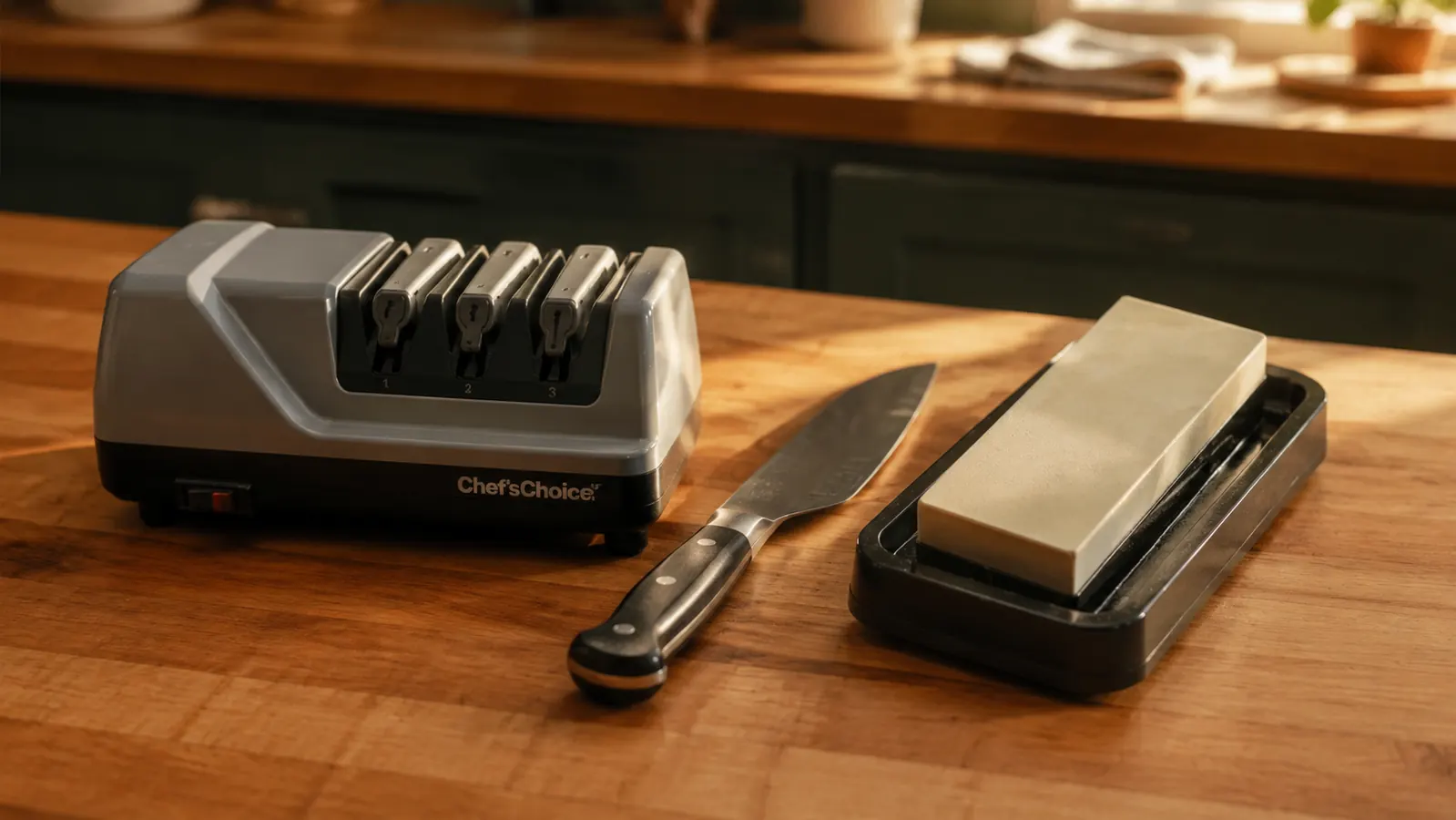
My friend Yvette has sharpened her chef's knife on a whetstone since culinary school, and for years she teased me about the Chef'sChoice 15XV EdgeSelect sitting on my counter like it was a shortcut for people who never bothered to learn the real skill. So I did what any stubborn recipe-tester would do. I borrowed her stone setup for six weeks, ran my own knife block through both methods side by side, and timed every single session with my phone instead of trusting either of our egos.
Short answer, since you're probably standing in a kitchen supply aisle right now trying to decide: the Chef'sChoice 15XV wins if you want a genuinely sharp edge in about three minutes without years of practice behind you. Yvette's whetstone can produce a marginally finer edge in patient, well-trained hands, hers included, but it demands real skill, real time, and a willingness to mess up an edge or two while you're learning the feel of it. If you cook on a schedule and not as a hobby, the electric sharpener is the one I'd point you toward across my kitchen island.
| Spec | Chef'sChoice 15XV EdgeSelect | Traditional Whetstone |
|---|---|---|
| Time Per Sharpening | About 3 minutes for a full three-stage session | 15 to 25 minutes once you factor in soaking and rinsing |
| Learning Curve | Guided slots hold the angle for you, usable well on your first try | Weeks of practice to hold a consistent angle by feel alone |
| Angle Consistency | Fixed 20-degree slots, same result every pass | Entirely dependent on your hand, varies session to session while learning |
| Edge Quality at Its Best | Sharp, reliable, polished edge every time | Can exceed the electric sharpener's edge once you've built real skill |
| Upfront Cost | Higher one-time cost for the unit itself | A single stone can be bought for less, though a full progression of grits adds up |
| Maintenance | Brush out metal filings from the slots monthly | Needs flattening over time as the stone wears unevenly |
| Countertop Footprint | Sits plugged in or stored, ready in seconds | Needs a soaking basin, a stable surface, and cleanup after every use |
| Serrated Blades | Dedicated slot restores bite to a bread knife | Requires a specialty technique most home cooks never learn |
How I Actually Tested Both, Side by Side
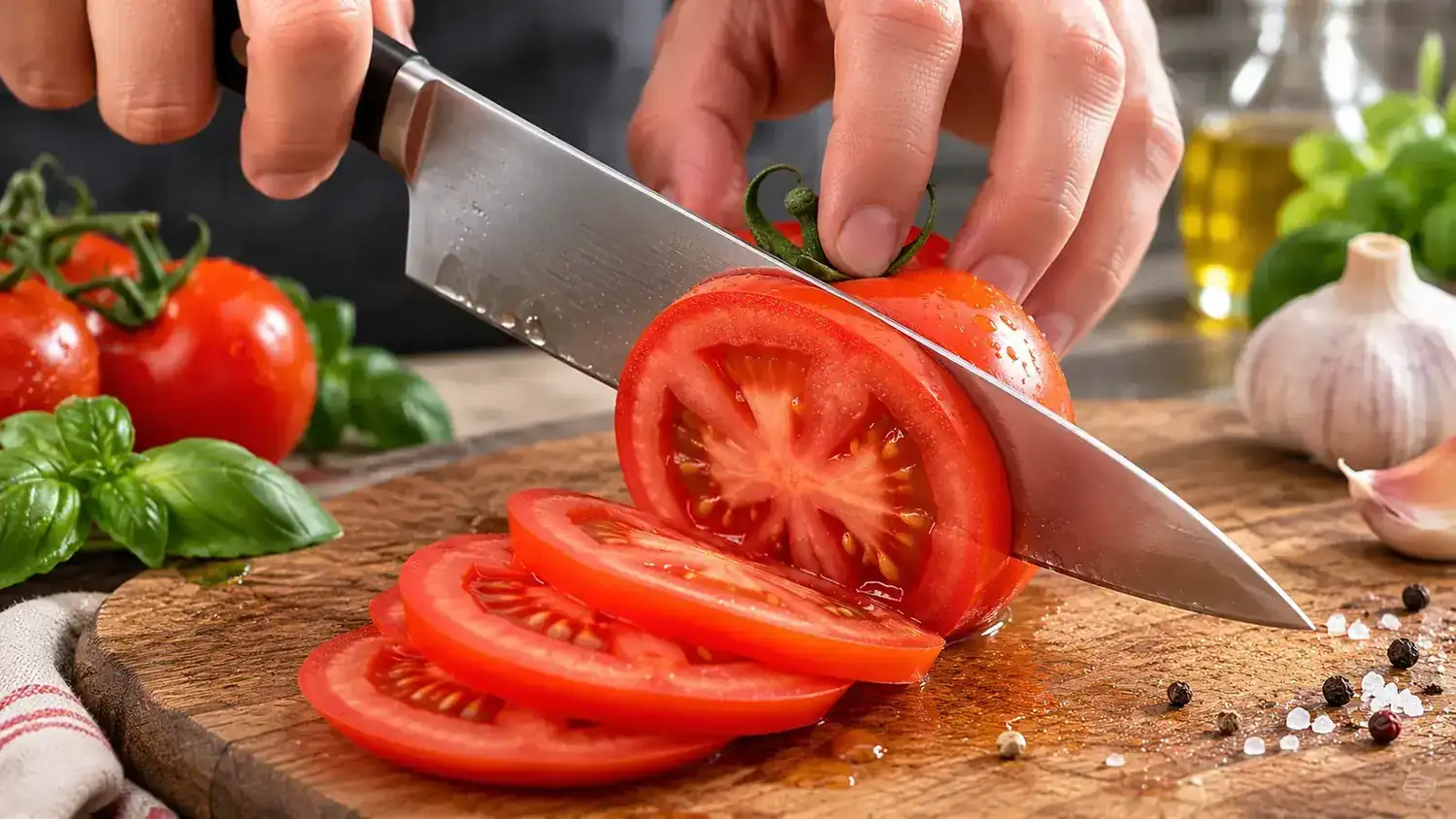
I didn't want a one-time comparison where I sharpened a knife once on each tool and called it a day. Over six weeks I alternated which method handled my main chef's knife each week, a Wusthof Classic I use daily, while running a second, identical Wusthof through the other method the entire time. Same tomatoes, same cutting board, same test at the end of every session: could the knife slice a ripe tomato skin without pressing down first.
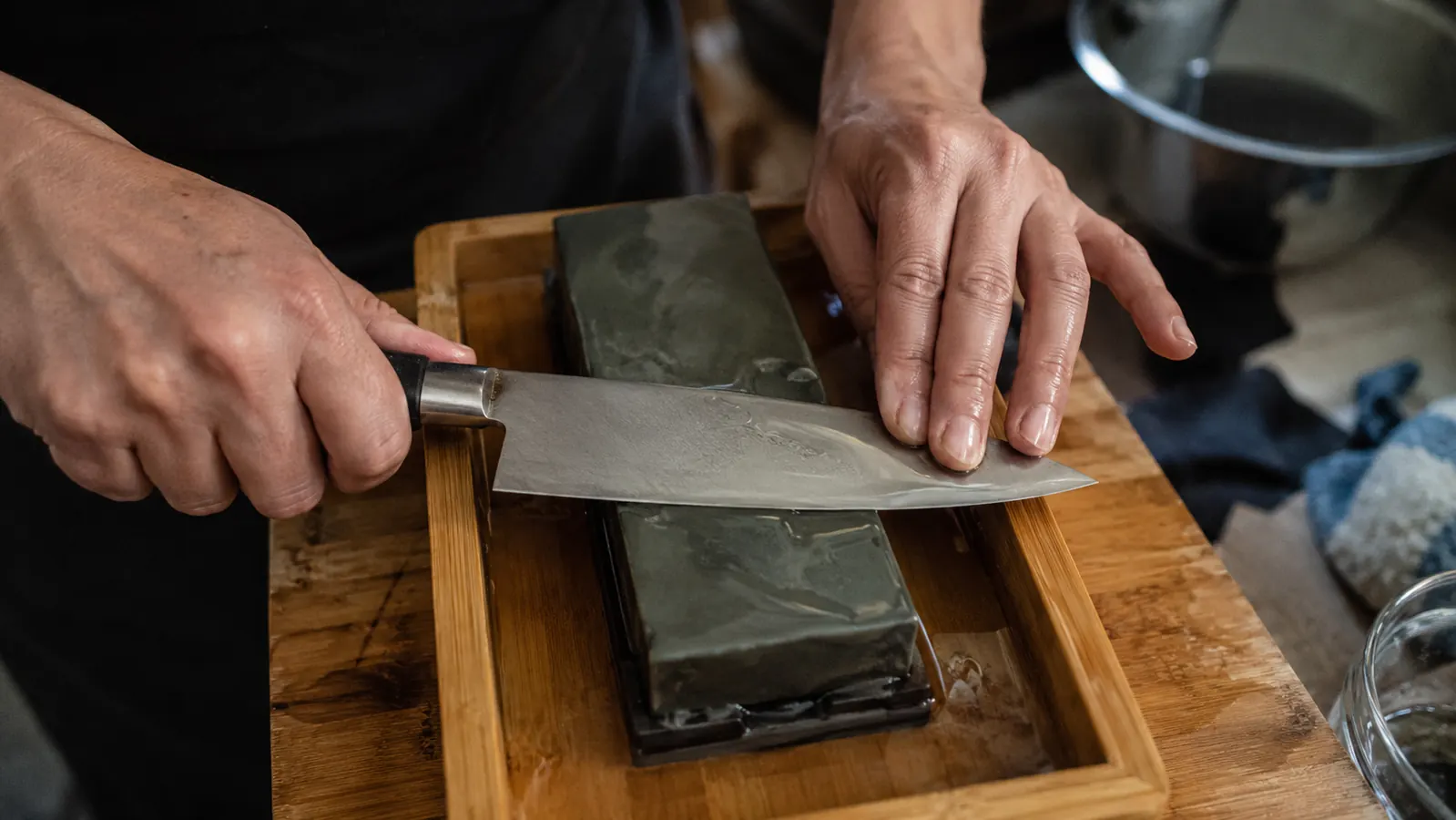
Yvette walked me through her stone setup the first week, a two-sided combination stone she keeps soaking in a bin under her sink, and I logged every session length with a kitchen timer sitting right next to the stone. I did the same with the Chef'sChoice, timing from the moment I picked up a dull knife to the moment it passed my tomato test. Six weeks, two knives, one very patient set of tomatoes.
I also tracked the mess each method left behind, since that's the kind of small detail that decides whether a tool actually gets used again next week. The Chef'sChoice leaves a light dusting of fine metal filings around its base that a damp cloth wipes up in seconds. Yvette's stone setup meant a soaking basin, a wet counter, and a small puddle by the sink every single time, which she doesn't mind because it's part of her routine, but which I found myself avoiding on busier nights simply because of the cleanup involved.
Where the Chef'sChoice Wins
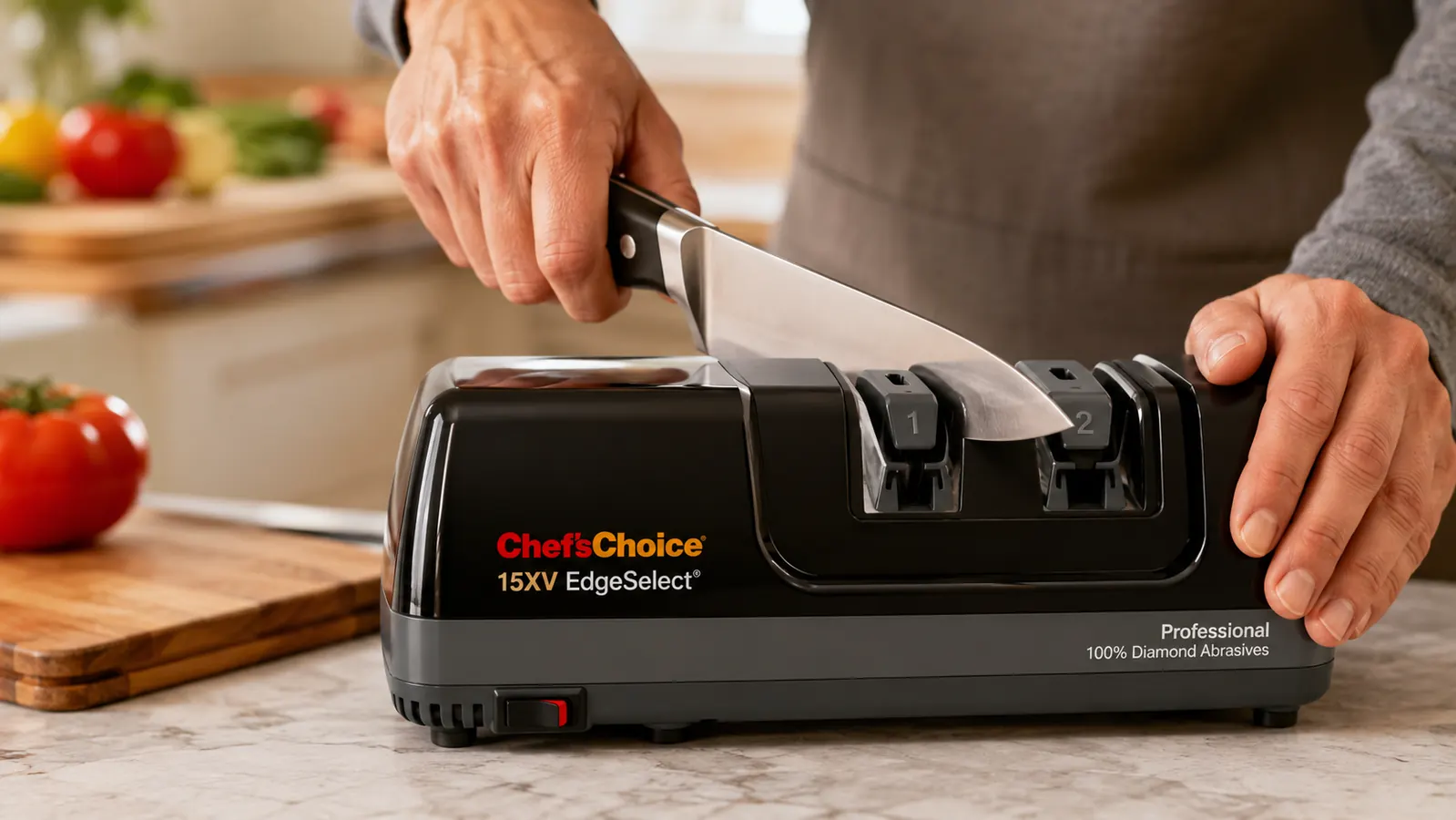
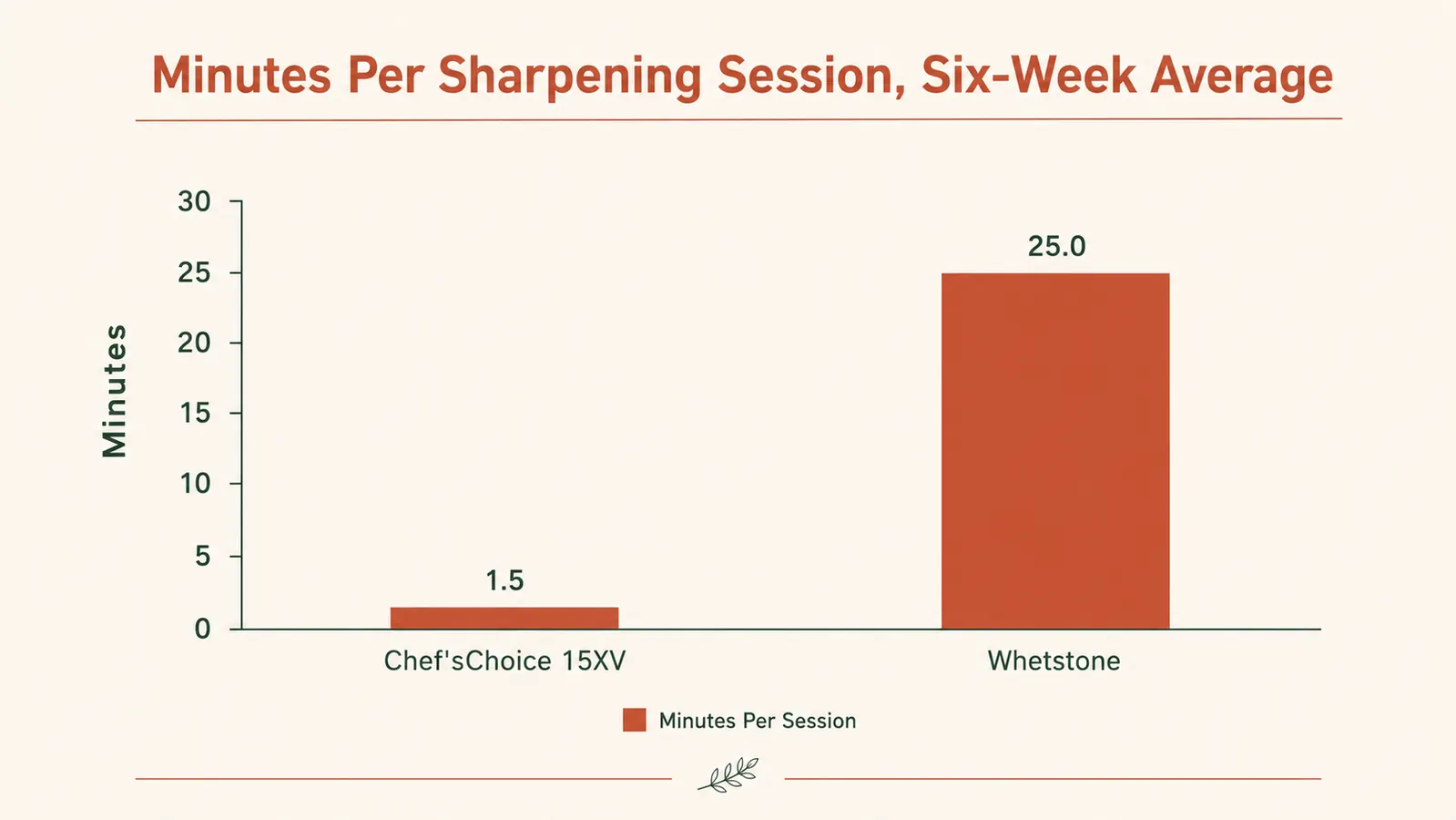
Speed was never close. My average full session on the Chef'sChoice, all three stages, ran just under three minutes, start to finish, including a quick brush-out of the slots afterward. My best session on the whetstone, after I'd had four weeks of practice, still took me almost eighteen minutes, and that's not counting the ten minutes I spent soaking the stone beforehand. On a weeknight when dinner still needs to happen, that difference is the entire decision for most people.
Consistency was the other place the electric sharpener pulled way ahead, and it's the reason I bought one in the first place three years ago. Every single pass through the Chef'sChoice's guided slots holds the blade at the same fixed 20-degree angle, so the knife I sharpened in week one and the knife I sharpened in week five came out with an identical edge. My whetstone sessions were nowhere near that even. My first two attempts actually left the knife slightly duller in one spot near the heel, where my angle had drifted without me noticing, something Yvette confirmed had happened to her too when she was first learning.
The dedicated serrated slot also earned its keep during this test in a way the whetstone simply couldn't match. I run my bread knife through it maybe four times a year, and it restores real bite without me needing to learn an entirely separate stone technique for serrated edges, which Yvette admitted she's never bothered to master either, even after years of sharpening straight blades.
Where the Whetstone Wins
I want to be fair here, because by week five, once I'd built a little more feel for the stone, the edge coming off Yvette's setup on her best attempts was noticeably finer than anything the Chef'sChoice produced. It's a difference you'd mostly notice on paper-thin cuts, like shaving a radish translucent for a garnish, rather than on everyday prep, but it was real. A whetstone, run by patient and practiced hands, removes less metal per session and can take an edge to a level a machine with fixed diamond wheels isn't really built to chase.
The other place the stone wins is upfront cost, if you're only ever planning to own one stone and never upgrade the grit progression. Yvette's basic combination stone cost her far less than the Chef'sChoice runs at today's price, and for someone who genuinely enjoys the ritual of sharpening as its own quiet task, that lower entry point matters. She also pointed out that a stone never needs batteries, motors, or replacement parts. Barring a chip, it lasts essentially forever.
There's also something to be said for the control a stone gives an experienced user over specialty blades. Yvette's carbon steel Japanese-style knife is ground at a much steeper angle than the Chef'sChoice's fixed 20 degrees, and she can match that exact bevel by hand in a way a guided electric sharpener simply isn't designed to do. If your knife block includes thin-bevel Japanese blades and you've put in the time to learn stone work, that flexibility is real and worth something.
The Chip That Almost Changed My Mind
In week three, my paring knife picked up a small chip near the tip after it slid off a stubborn butternut squash and caught the edge of the cutting board. I ran it through the Chef'sChoice's coarse Stage 1 slot expecting the chip to disappear in a pass or two, and it mostly did, but it took several more passes than a clean dull edge would have needed, and I could feel the machine removing more metal than I was fully comfortable with. Yvette took a look at the same chip on my second paring knife and worked it out by hand on her coarsest stone in about the same total time, but with noticeably less metal loss, because she could focus the pressure exactly on the damaged spot instead of running the whole edge through a fixed slot.
That moment was the closest the whetstone came to winning me over completely. For everyday dullness, the fixed slots on the Chef'sChoice are exactly what I want, fast and foolproof. For actual damage, a chip, a rolled edge, a knife that's been through something rough, a skilled hand with a stone has more control. It didn't change which tool lives on my counter day to day, but it did change how I think about the two, less as competitors and more as two different jobs that happen to use the word sharpening.
Cost and Maintenance Over Time
The Chef'sChoice's ongoing cost is mostly time, not money. Brushing metal filings out of the abrasive slots takes about thirty seconds and needs doing roughly once a month if you're sharpening weekly, and beyond that the diamond wheels themselves have shown no real wear on mine after three years of regular use. Yvette's stone, on the other hand, needs periodic flattening on a separate flattening stone as the surface wears unevenly from repeated use in the same spots, something she does every couple of months and considers a normal part of stone ownership rather than a downside.
Neither tool asked either of us to spend real money again after the initial purchase, which is worth saying plainly, since a lot of kitchen gadgets quietly nickel-and-dime you with proprietary refills. The honest cost difference over time comes down to which upkeep task you'd rather do: a quick monthly brush-out, or an occasional flattening session that takes real attention and a second stone to do properly. For me, the thirty-second brush-out wins every time. For Yvette, the flattening ritual is part of why she likes stone sharpening in the first place.
Skip the eighteen-minute learning curve and get a real edge tonight.
The Chef'sChoice 15XV EdgeSelect holds a fixed 20-degree angle across three diamond abrasive stages, so you get a consistent, reliable edge in about three minutes without months of stone practice.
Amazon Check Today's Price on Amazon →Who Should Buy Which
If you cook on a weeknight schedule, own a set of Western-style knives, German or that general family of steel, and want them consistently sharp without carving out a learning period, the Chef'sChoice is the clear pick. It's also the better call if you're the one sharpening for the whole household, since the three-minute cycle time means you can get through a full knife block in one sitting instead of dreading the job. The whetstone makes more sense if sharpening is something you actually want to get good at for its own sake, if your knife collection leans toward thin-bevel specialty blades, or if you've already got the patience Yvette had to build over years before her stone sessions started beating a machine on edge quality.
If you're weighing this purely on budget, remember that the number on the box isn't the whole story. A stone that sits unused in a drawer because the learning curve felt like too much homework isn't actually saving you anything, it's just a knife block full of dull knives and a guilty conscience. The tool that actually gets used every week is the one that's worth buying, and for six weeks running, that was the Chef'sChoice sitting next to my cutting board, not the stone soaking in Yvette's sink.
Yvette and I still argue about this over dinner more than either of us would like to admit, but even she's conceded that the Chef'sChoice is the tool she'd recommend to a friend who just wants their knives sharp with the least amount of fuss. She's keeping her stone, and I'm keeping my sharpener, and honestly, that's probably the right outcome for both of us.
Three minutes to a sharp knife, no stone-soaking required.
If a dull chef's knife has been quietly making every dinner prep harder than it needs to be, the Chef'sChoice 15XV EdgeSelect is the tool I'd hand you before I'd hand you a stone.
Amazon Check Today's Price on Amazon →