
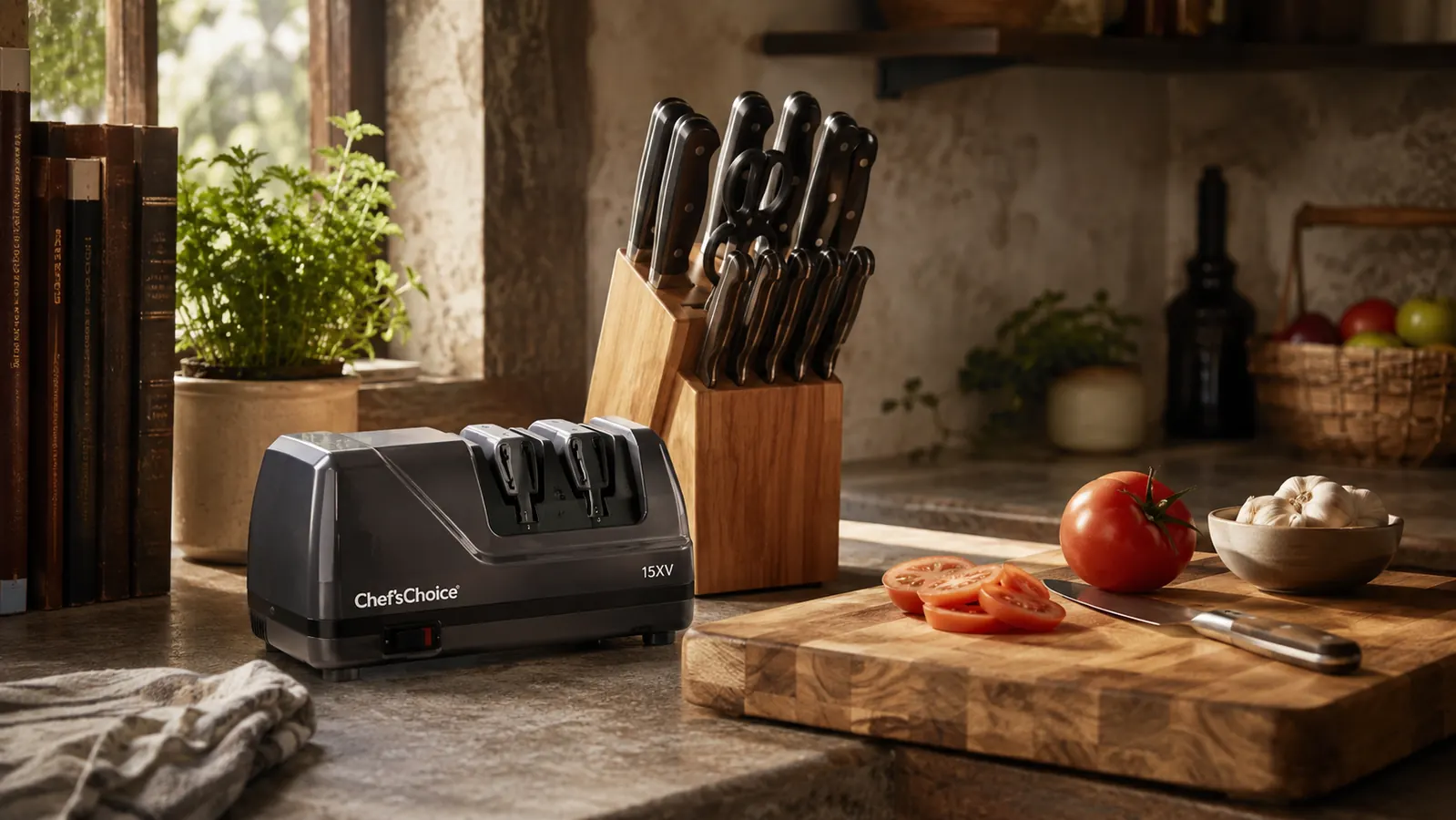
I bought the Chef'sChoice 15XV EdgeSelect three years ago, the same week I nearly ruined my favorite Wusthof santoku trying to freehand it against a cheap pull-through gadget I'd had shoved in a drawer for a decade. That pull-through had been rounding my edges instead of sharpening them for who knows how long, and I only noticed when the santoku started squashing tomatoes instead of slicing them. I wanted something that would give me a real, repeatable angle without asking me to develop whetstone skills I didn't have time to learn.
Three years later, that Chef'sChoice still lives on my counter, not tucked away in a cabinet, and I've run somewhere north of 200 sharpening sessions through it across a knife block that includes two Wusthofs, a Victorinox paring knife, a serrated bread knife, and a cheap utility knife I keep around for opening boxes. This isn't a spec-sheet review. It's what actually happened to my edges over three years of real weeknight cooking.
The Quick Verdict
A genuinely reliable diamond-wheel sharpener that rescued a knife I'd nearly given up on and has kept my whole block working since, with a learning curve on angle consistency that took me a few tries to get right.
Amazon Check Today's Price →Tired of a chef's knife that squashes tomatoes instead of slicing them?
The Chef'sChoice 15XV EdgeSelect uses 100 percent diamond abrasive wheels set to a consistent 20-degree angle, so you get a real edge back without freehand guesswork.
Amazon Check Today's Price on Amazon →How I've Used It
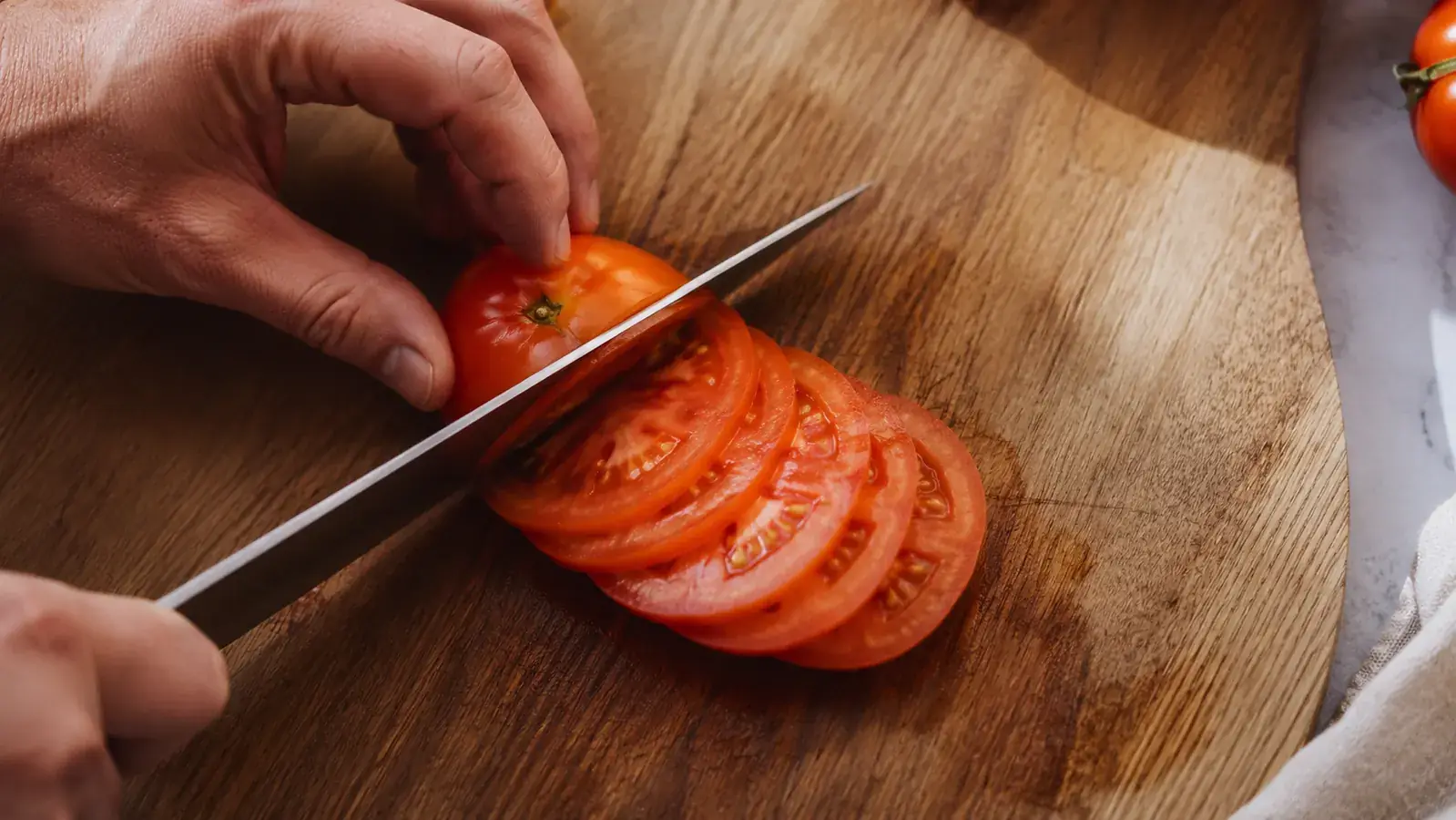
My routine is unglamorous. The 15XV sits on a folded kitchen towel next to my knife block, and I run a full three-stage sharpening on my main chef's knife roughly once a month, with quick single-pass touch-ups on Stage 3 whenever a knife starts dragging instead of slicing through a tomato skin. That's the real test I use in my kitchen, not a sheet of paper. If the tomato skin resists even slightly, it's time for a pass through the machine.
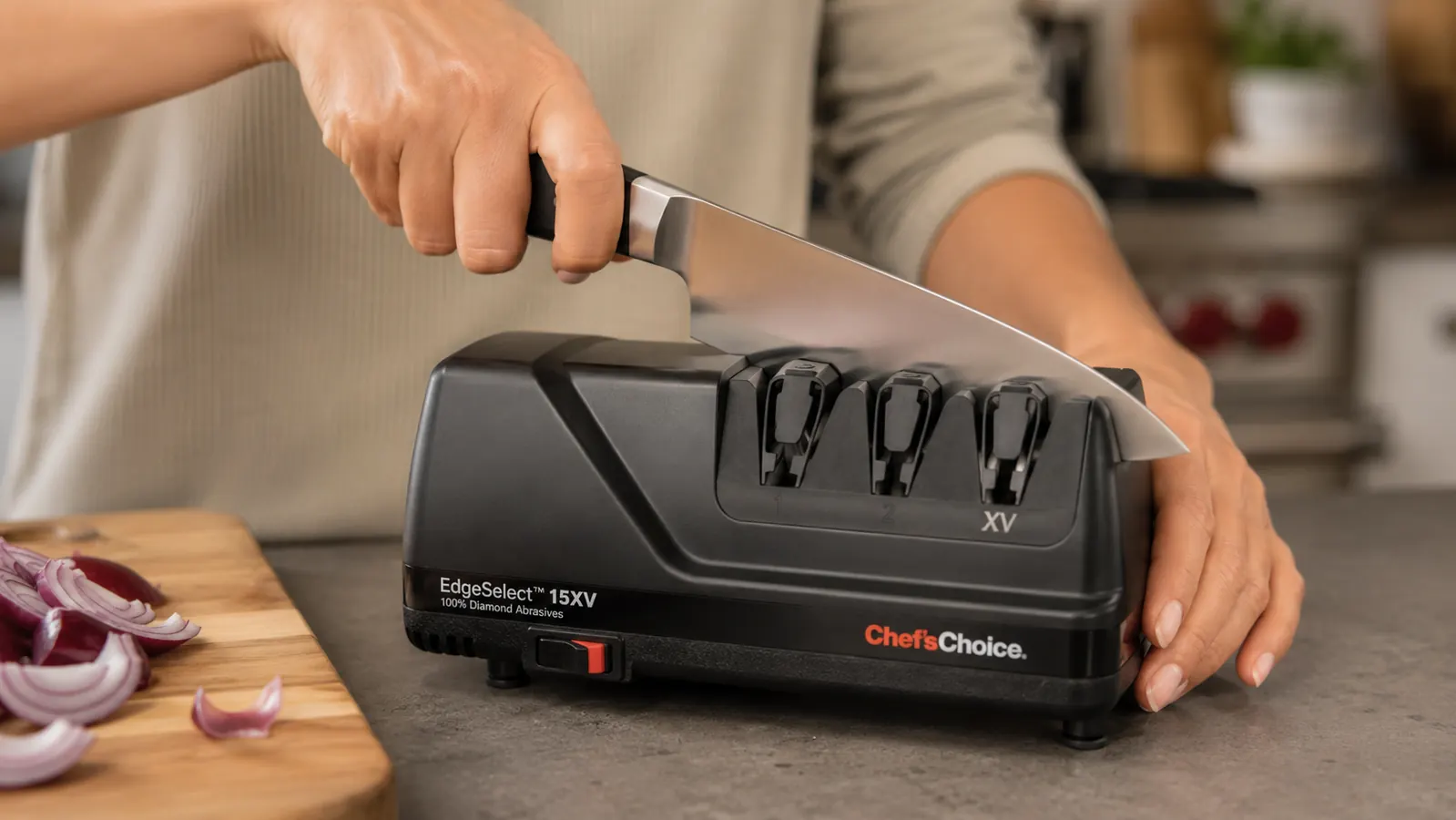
The three stages are straightforward once you've done it a handful of times. Stage 1 is coarse diamond abrasive for a knife that's genuinely dull or has a small chip, Stage 2 is fine diamond for regular maintenance, and Stage 3 is a flexible stropping disk that polishes the edge and knocks off the microscopic burr the first two stages leave behind. I learned the hard way in my first month that skipping Stage 3 leaves the edge feeling sharp but slightly rough, almost like a fine-toothed saw instead of a clean blade.
The knives that go through it most are my two Wusthofs, a chef's knife and a santoku, plus a Victorinox paring knife I use daily for produce prep. My serrated bread knife gets maybe four passes a year through the dedicated serrated slot, and honestly that's plenty, since serrated edges hold up longer between sharpenings than straight ones do in my experience.
Cleanup is part of the routine too, and it took me longer than I'd like to admit to build that habit. A quick wipe of the counter with a damp cloth catches the fine metal dust that settles around the base after a Stage 1 pass, and I keep the sharpener a few inches from my cutting board so none of that dust ends up near produce. Three minutes of sharpening, one minute of cleanup, and I'm back to prepping dinner with an edge that actually does its job.
The Diamond Abrasive Wheels and Why the 20-Degree Angle Matters
Before this machine, my biggest problem wasn't dullness, it was inconsistency. Every time I tried to freehand a knife against a stone or a cheap guided rod, I'd end up with a slightly different angle on each side, which meant an edge that looked sharp but cut crooked, pulling to one side through a carrot instead of tracking straight. The 15XV's slots hold the blade at a fixed 20-degree angle per side, and that fixed geometry is the entire reason this thing works for someone like me who never quite mastered a whetstone.
The diamond abrasive itself has been the more durable part of the system than I expected going in. Three years of monthly use on a rotating cast of five or six knives, and I haven't noticed the wheels losing their bite the way I worried they might. I keep waiting for Stage 1 to feel less aggressive, and it just hasn't happened. That matters because a sharpener that dulls out itself after a year isn't actually saving you money over a professional sharpening service.
Three Years of Edge Retention: What Sharpening Actually Fixed
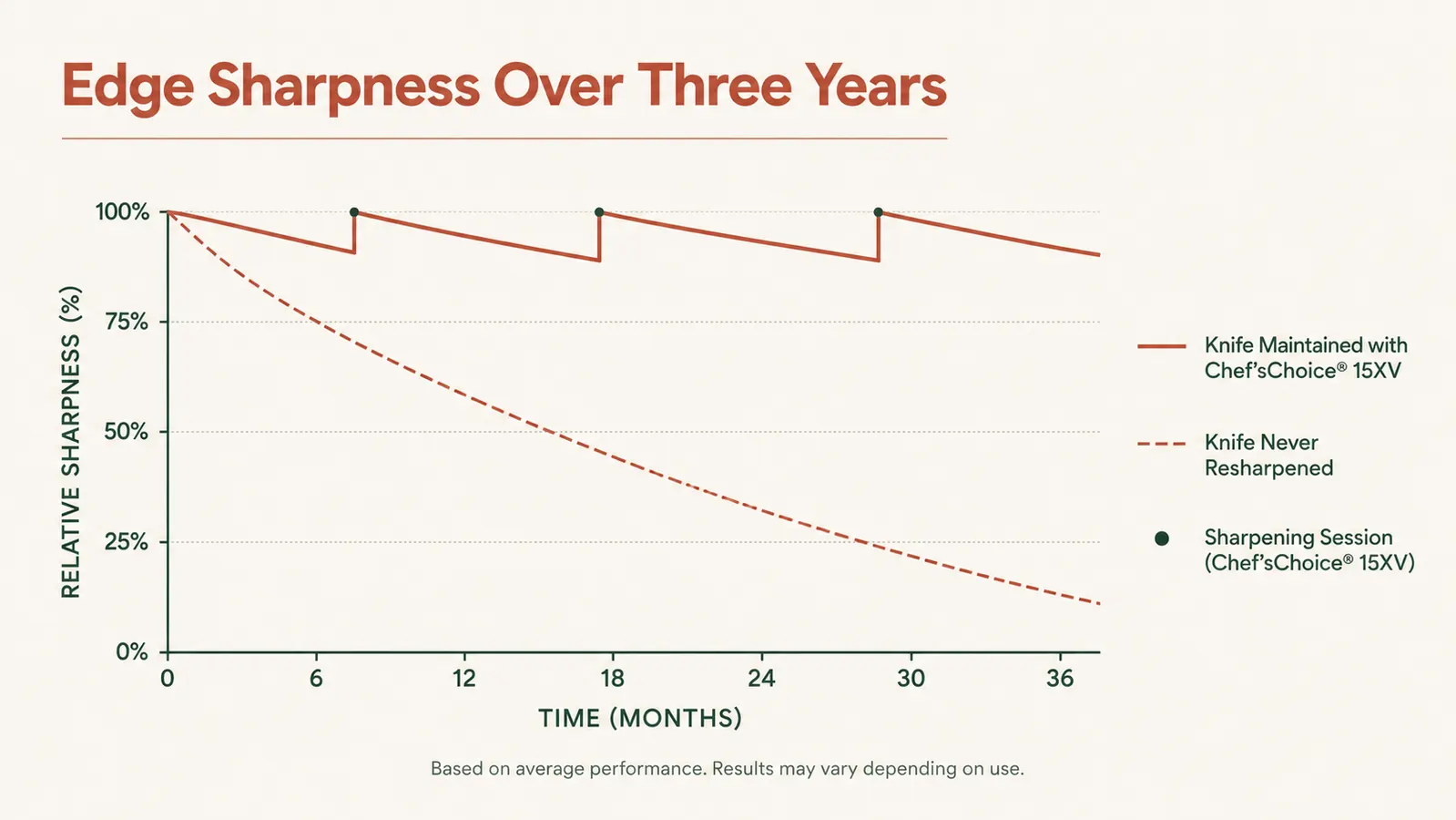
The Wusthof santoku that started this whole search is the clearest before-and-after story I have. It went from squashing tomato skins to slicing them cleanly again after one full three-stage pass, and I've kept it in rotation with a monthly Stage 3 touch-up ever since. Three years later it's still my go-to knife for prep work, which is longer than I've ever kept a chef's knife performing well without professional sharpening.
My cheap utility knife told a different story. I ran it through the full three stages expecting a dramatic improvement, and it did get noticeably sharper, but the edge didn't hold nearly as long as it does on my Wusthofs. Within two weeks it was dragging again on cardboard. That's not really the machine's fault, it's the steel. A cheap utility knife just doesn't hold an edge the way a higher-carbon German or Japanese-style blade does, and this sharpener made that difference obvious to me in a way I hadn't fully appreciated before.
The Victorinox paring knife has been the pleasant surprise of the whole three years. I sharpen it maybe every six weeks, and it comes back nearly as sharp as it was out of the box every single time. Softer steel means it dulls faster during use, but it also responds beautifully to the diamond wheels, taking an edge quickly without much resistance. If I had to guess which knife has been sharpened the most times on this machine, it's that one.
I also keep a rough log the same way I used to track recipe tests professionally, a sticky note inside a cabinet door with the date and knife next to each sharpening. Looking back over three years of those notes, the pattern is obvious. Knives I use daily need Stage 3 touch-ups roughly monthly, and full three-stage sessions only come up when I've let a knife go longer than I should have, usually during a stretch of busy weeks when sharpening slips down the priority list.
Serrated Blades, Chef's Knives, and the One Knife It Struggled With
The serrated slot handles my bread knife well enough that I stopped avoiding sourdough because of a dull edge dragging and tearing the crust. It's not a full re-profile the way a professional serrated sharpening service would do, but it restores enough bite that the knife saws cleanly through a crusty loaf instead of crushing it flat, which is really all I ever needed from it.
The one knife that genuinely struggled through this machine was an old carbon steel Japanese-style knife a friend gave me, ground at a much steeper angle than the 20-degree default. Running it through the 15XV effectively reground the edge to the machine's angle, which worked, but it took several passes and I could tell I was removing more metal than a knife with that thin an original bevel should probably lose. I've since set that one aside for hand sharpening and reserve the Chef'sChoice for my Western-style knives, which is really what it's built for.
Where the 15XV Has Held Up, and Where It Hasn't
The motor and the wheel assembly have been the reliable core of this machine. No grinding noise, no slowdown, no burnt-motor smell after long sessions, which is the thing I half expected given how cheap some kitchen gadgets feel after eighteen months. I run it hard during holiday cooking weeks when every knife in the house needs attention at once, and it hasn't once complained.
The rubber feet on the bottom are the one part that's shown real wear. They've flattened slightly over three years of sliding on and off my counter towel, and the unit walks a little more than it used to during an aggressive Stage 1 pass. It's a minor annoyance, not a failure, but I've started holding the housing steady with my off hand during coarse sharpening, something I never had to think about the first year.
The abrasive slots do collect metal filings over time, and cleaning them out with the small brush that came in the box became part of my monthly routine somewhere around month four. Skip that step for too long and you'll notice the sharpening feels less consistent, almost gritty, which I learned after a stretch of neglecting it during a busy summer.
The learning curve deserves an honest mention too. My first two or three sessions produced edges that were better than dull but not quite what I knew this machine was capable of, mostly because I was pulling the knife through the slots too fast, trying to rush the process the way I would with a honing rod. Slowing down, using consistent light pressure, and letting each pass do its own work made the difference between a good edge and a great one, and that took me a good month to internalize.
The Whetstone I Almost Bought Instead
Before landing on the 15XV, I seriously considered a whetstone setup instead, mostly because two chefs I trust swear by theirs. What kept me from going that route was time and consistency. A whetstone can produce a superior edge in the right hands, but it demands practice, patience, and a steady angle you hold entirely by feel. I recipe-test on a deadline most weeks, and I needed something I could trust to work in three minutes without a learning curve I didn't have time for.
I also looked at a cheaper pull-through sharpener, essentially an upgraded version of the one that damaged my santoku in the first place, and decided the fixed-angle guided slots on the Chef'sChoice were worth paying more for. A pull-through with springy carbide inserts is fast, but it's also removing metal without much control over the actual angle, and I'd already learned that lesson once the expensive way.
What I Liked
- Fixed 20-degree slots give a consistent angle without any freehand skill required
- Diamond abrasive wheels have shown no noticeable dulling after three years of monthly use
- Three-stage system (coarse, fine, stropping) produces a genuinely polished edge, not just a sharp-feeling one
- Dedicated serrated slot restores real bite to a bread knife without a separate tool
- Motor and wheel assembly have run reliably through heavy holiday-week use with zero issues
Where It Falls Short
- Struggled with a steeply-ground Japanese-style carbon steel knife, removing more metal than felt necessary
- Rubber feet have flattened slightly and the unit can walk a bit during aggressive Stage 1 passes
- Abrasive slots need monthly brushing out or sharpening feels gritty and inconsistent
- Softer steel knives dull faster after sharpening, which isn't the machine's fault but is worth knowing
- Not a substitute for a whetstone if you're after the very finest possible edge and have time to learn one
The motor has run three years of monthly use without a single complaint. The part that's actually worn down is a set of rubber feet, and that told me where this machine's real value sits, in the wheels, not the housing.
Who This Is For
This is for the home cook who owns a decent set of Western-style knives, German or that general family of steel, and wants them to stay genuinely sharp without learning a whetstone or paying a sharpening service every few months. If you've ever squashed a tomato instead of slicing it and blamed the tomato, this machine solves that specific problem faster than almost anything else I've tried. It's also a good fit if you cook daily enough that dullness sneaks up on you gradually, since a monthly routine catches it before you notice how bad it's gotten.
It's also a strong pick for anyone who bakes bread regularly, since the serrated slot alone justified the purchase for me on the sourdough front. And if you're the person in your house who ends up sharpening everyone else's knives too, the three-minute cycle time means you can actually get through a full block in one sitting instead of dreading the job.
Who Should Skip It
If you own thin-bevel Japanese knives ground at a steeper angle than 20 degrees, or you're chasing the absolute finest edge a whetstone can produce and you're willing to put in the practice time, this isn't the right tool for those specific knives. It's also probably overkill if you own one or two knives you sharpen twice a year, where a simple honing rod and an occasional professional sharpening would cover you just fine.
Three years and my whole knife block still cuts the way it should.
If a dull chef's knife has been quietly making every dinner prep harder than it needs to be, the Chef'sChoice 15XV EdgeSelect is the one I'd point to across my kitchen island.
Amazon Check Today's Price on Amazon →