
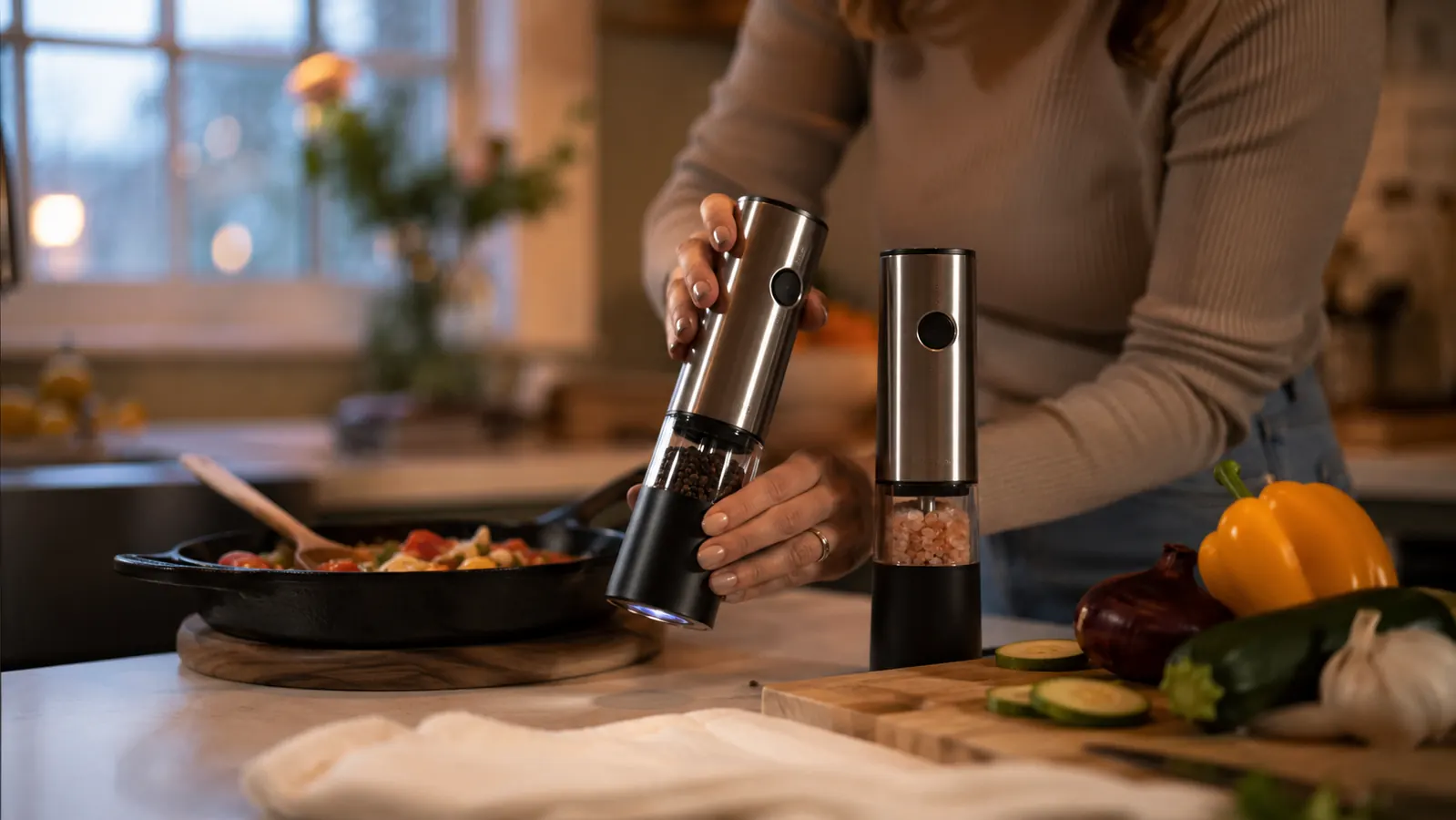
I've had the Circle Joy gravity electric salt and pepper grinder set sitting on my counter for the better part of a year now, and after twenty years of recipe-testing my way through cheap gadgets that get donated or tossed within a month, that alone tells you something. I bought the set last spring after breaking my third manual pepper mill in as many years, the kind where the grind mechanism seizes up the moment you actually need cracked pepper fast, mid-sear, with a pan already smoking. I wanted to see if a tilt-to-grind electric version would actually survive real weeknight cooking or just look nice in a photo for a week before dying quietly in a drawer.
That year is up now. I've run this pair through what I'd guess is somewhere north of 300 individual grinds, everything from a quick crack of pepper over scrambled eggs to seasoning a full brisket for a backyard crowd, and I've got specific opinions about what actually holds up versus what's just a nice feature on the box. This isn't a spec-sheet writeup. It's what happened on my island, with my own hands, over twelve real months.
The Quick Verdict
A genuinely convenient gravity grinder that earned a permanent spot next to my stove, with a battery habit and a coarseness dial that both took some getting used to.
Amazon Check Today's Price →Tired of wrestling a stuck pepper mill with one greasy hand?
The Circle Joy gravity electric grinder set activates with a simple tilt, so you get fresh cracked salt and pepper one-handed, right over a hot pan, without ever putting down your tongs.
Amazon Check Today's Price on Amazon →How I've Used It
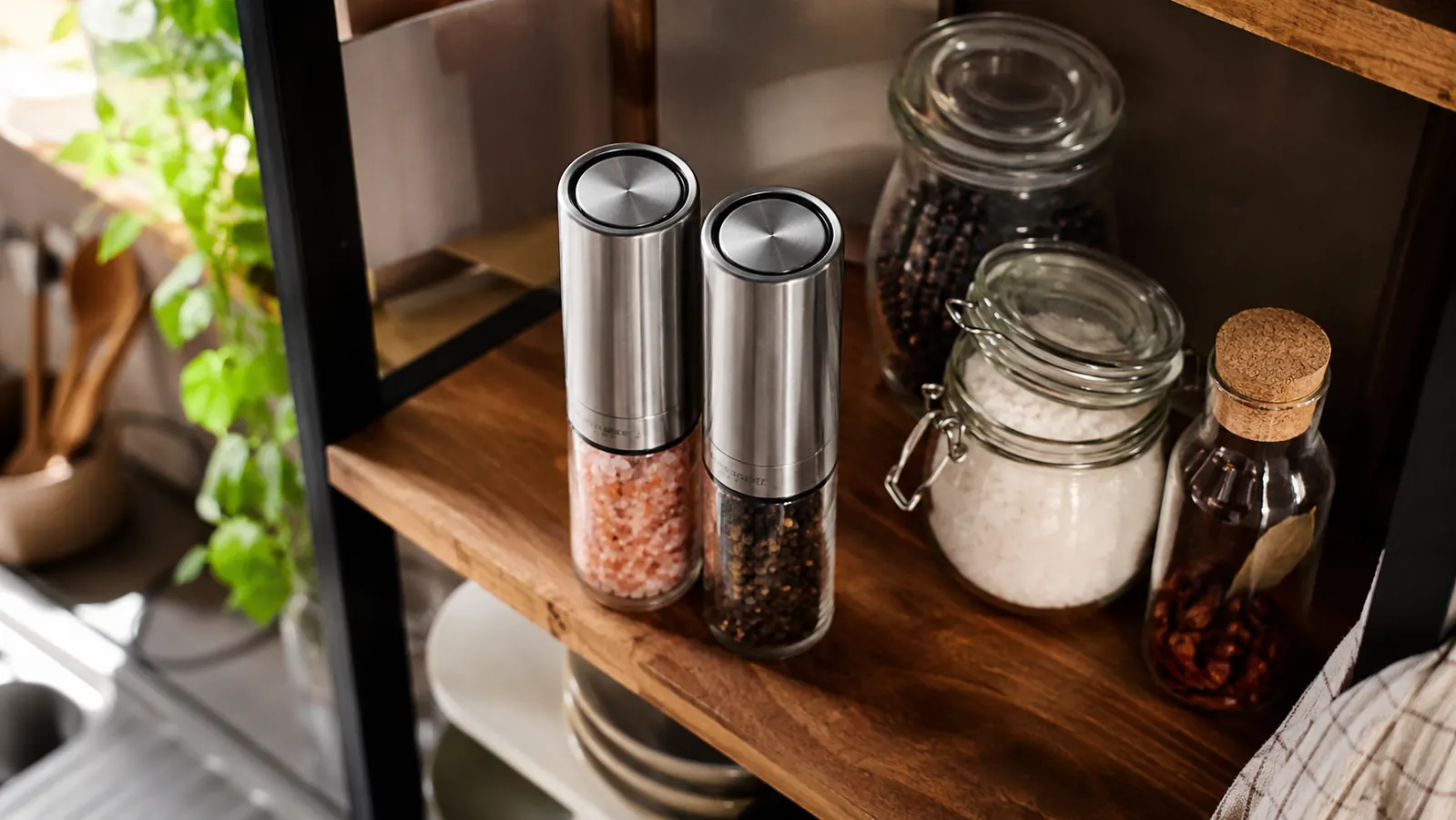
My setup is simple: the salt grinder lives on the left of my stove, the pepper grinder on the right, both standing upright next to my spice rack where they've stayed put since the day I unboxed them. I use them almost every time I cook, which in my house is five or six nights a week, plus weekend batches of soup and chili that eat through peppercorns faster than I expected.
The gravity sensor is the whole pitch, and it's the part I was most skeptical about walking in. You tilt the grinder sideways, a light activates, and it grinds automatically until you set it back upright. No twisting, no squeezing a trigger with a hand that's holding a spatula. The first week I used it constantly just to test whether it would misfire on the counter or grind itself dry when nobody was watching. It never did. The sensor only fires when it's actually tilted past a real angle, not just bumped.
I also learned pretty quickly to keep it away from the edge of the counter. Both grinders are lighter than a manual mill, which is part of why the tilt mechanism works so smoothly, but that same lightness means a stray elbow can send one sliding. I've caught mine twice mid-fall over the year, and once it didn't survive the catch, more on that below.
I also folded the set into how I test recipes for other people, not just my own family dinners. When I'm writing up a recipe card and need to note an exact seasoning step, having a dial I can set once and trust to repeat the same coarseness for the next reader has actually made my own notes more accurate, something a manual mill with inconsistent hand pressure never gave me.

The Tilt Sensor: Does It Actually Hold Up Daily?
Twelve months in, the tilt sensor is the single feature that's changed my actual cooking behavior, not just my opinion of the product. When I'm searing chicken thighs with one hand on tongs and the other holding a hot lid, being able to nudge the grinder sideways with a knuckle and get an even crack of pepper directly into the pan is the kind of small convenience that sounds trivial until you've lived without it for twenty years of professional recipe testing.
The blue LED that lights up during a grind isn't just decoration either. It's genuinely useful at night or in a dim kitchen, since you can see at a glance whether it's actively grinding or just sitting tilted and stalled. I noticed early on that if I tilt it too gently, sometimes the light flickers on but the grind mechanism doesn't fully engage, and I've learned to commit to a firmer tilt rather than a lazy lean.
Where the sensor has been less impressive is consistency across both units. The pepper grinder has been rock solid from day one. The salt grinder occasionally needs a second tilt to kick in, especially after it's sat unused for a few days, which I chalk up to fine salt dust settling around the sensor contact rather than a design flaw, since a quick wipe-down usually fixes it.
Grind Consistency Over a Year of Daily Use
The adjustable coarseness dial at the base is where I spent the most time in month one, dialing between a fine table-salt texture and a coarse crack for finishing a steak. Once I found my two go-to settings, fine for the salt grinder and medium-coarse for the pepper, I stopped touching the dial almost entirely, which I actually count as a point in the product's favor. A gadget I have to recalibrate every use is a gadget I eventually stop reaching for.
The ceramic grinding mechanism has stayed sharp through everything I've thrown at it, including the oilier Tellicherry peppercorns I buy in bulk that tend to gum up cheaper mills within weeks. I never noticed a slowdown in grind speed or a change in texture from month one to month twelve, which is more than I can say for the last two manual mills I owned before this.
The one consistency complaint I have is on the coarsest setting, where the grind occasionally comes out uneven, a mix of properly cracked pepper and a few larger chunks that need a second pass. It's a minor annoyance, not a dealbreaker, but if you're chasing restaurant-uniform cracked pepper for a specific plating, you'll notice it.
I ran a rough side-by-side against my old wooden mill during month three, grinding the same peppercorns through both onto separate plates, mostly to settle an argument with my husband about whether electric grinders actually produce a finer, more even result. They did, noticeably, and it's the one comparison from this whole year that turned him from a skeptic into someone who reaches for the Circle Joy set without me asking.
Battery Life and the Refill Routine
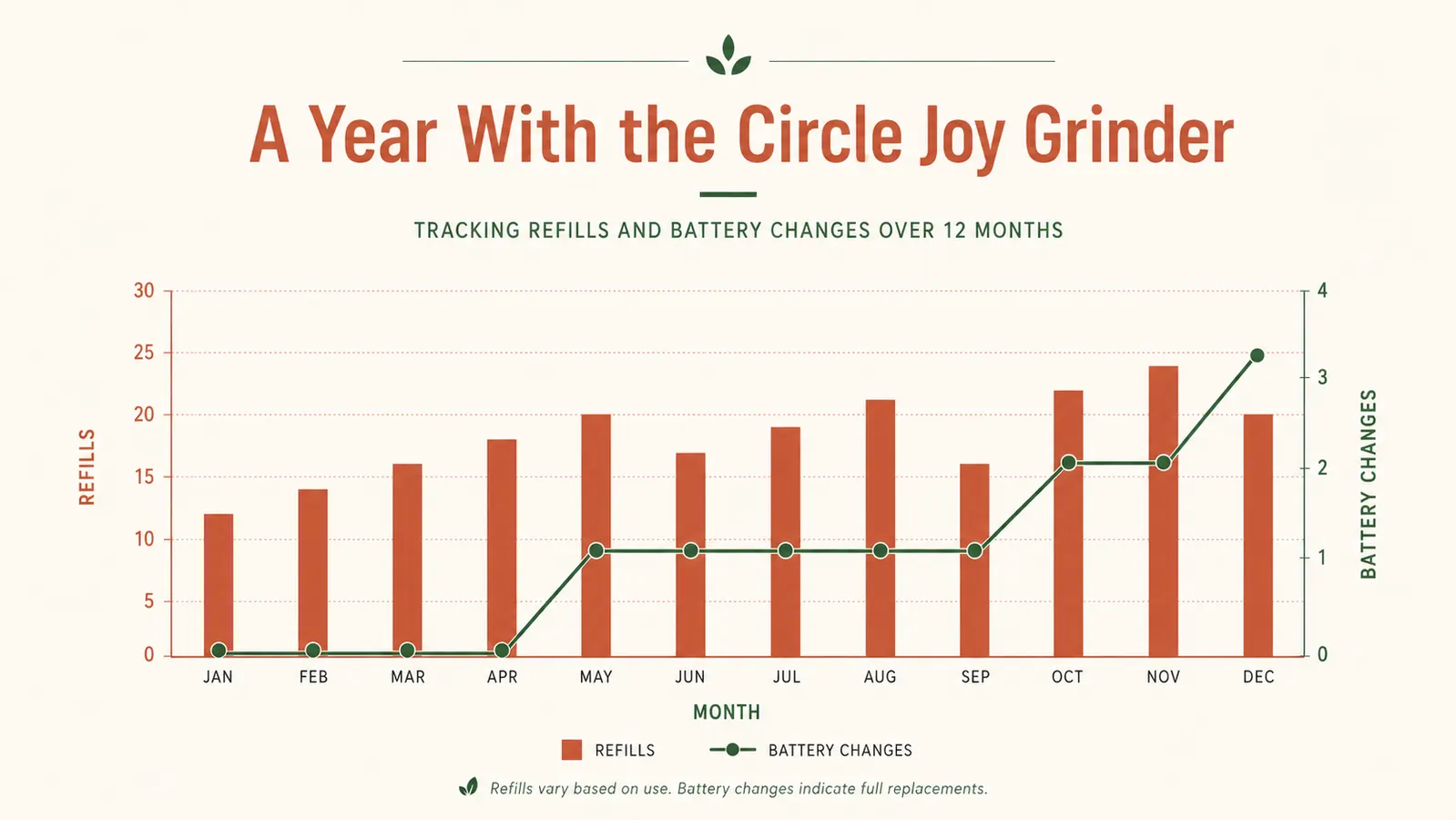
Each grinder runs on AA batteries housed in the base, and over twelve months I've swapped batteries three times per unit, which lines up with roughly one change every four months given my nightly use. That's better battery life than I expected walking in, and I never had a grinder die mid-cook, which is the scenario that would have actually annoyed me.
Refilling is where the design earns real points. Both the salt and pepper chambers unscrew from the top with a simple twist, no tools, no prying off a stubborn cap the way I've had to with cheaper mills. I refill the pepper grinder roughly once a month with whole peppercorns and the salt grinder about every six weeks with coarse sea salt, and neither refill takes more than thirty seconds.
The one thing I wish the packaging had mentioned upfront is that it doesn't ship with batteries included, which meant my first attempt at using it fresh out of the box was a five-minute detour to the junk drawer. Small thing, but worth knowing before you plan a dinner around unboxing it that same night.
Where It's Held Up, and Where It Hasn't
The motor and sensor mechanism have been the standout performers. No grinding down in power, no strange noises, nothing that suggests the internals are wearing out the way I half expected from a modestly priced gadget. If durability of the core mechanism is your worry, a year of near-daily use hasn't given me a reason to worry.
The lid seal on the salt grinder is the one part that's shown real wear. Around month eight I noticed a faint dusting of fine salt collecting at the base of the unit, which told me the seal around the refill cap had loosened slightly with repeated twisting. It hasn't affected function, but I now wipe the counter under it more often than I do under the pepper grinder.
And then there's the drop. Around month five, my elbow caught the pepper grinder off the edge of the counter and it hit the tile floor. The body survived without a crack, but the tilt sensor became noticeably less sensitive afterward, needing a firmer angle to activate than it used to. It still works, and I haven't replaced it, but that's the honest scar this review has to include rather than pretend it doesn't exist.
I also keep a soft cloth near the stove now, something I didn't do with my old manual mill, because a fine haze of ground pepper does settle on the counter around the base after a heavier grind session. It wipes up in seconds, but if you're precious about a spotless countertop between meals, it's worth knowing this isn't a completely mess-free tool.
Alternatives I Considered Before Buying
Before landing on the Circle Joy set, I looked hard at staying with a manual mill, specifically the wooden pepper mill my mother-in-law swears by. What tipped me toward electric was purely a kitchen-workflow issue, the number of times I need seasoning with one hand occupied has only gone up as my recipe testing schedule has gotten busier, and a manual mill simply can't compete with a one-handed tilt.
I also briefly considered a battery-free, crank-style electric grinder from a competing brand, the kind you squeeze rather than tilt. I tested a friend's for a weekend and found the squeeze trigger tired my hand out faster during a long cooking session than the Circle Joy's tilt ever has, since tilting uses gravity rather than grip strength.
And I nearly went with a single combo unit that houses both salt and pepper in one body instead of buying a matched pair. I decided against it because I wanted to be able to grind salt with one hand and pepper with the other during a busy dinner without juggling a single unit back and forth, and having two separate grinders turned out to be worth the extra counter space.
What I Liked
- One-handed tilt activation is genuinely useful mid-cook, not just a gimmick
- Ceramic grinding mechanism has stayed sharp through a full year of near-daily use
- Refill caps unscrew easily, no tools or prying required
- Battery life held up to roughly four months per swap under nightly use
- Coarseness dial holds a setting once you dial it in, no constant recalibration
Where It Falls Short
- Batteries are not included, plan for a junk-drawer detour on unboxing day
- Salt grinder's lid seal has loosened slightly, small dusting of salt around the base
- Coarsest setting can grind unevenly, occasional larger chunks mixed in
- Lightweight body means it's easy to knock off the counter edge
- Tilt sensor got noticeably less sensitive after one hard drop
The mechanism itself never slowed down in a year of near-nightly use. The one thing that actually wore was the salt grinder's seal, and that told me exactly where this set's honest weak point sits.
Who This Is For
This is for the home cook who's tired of stopping mid-sear to wrestle a stuck manual mill with a greasy hand, or who just wants one less thing to think about while juggling tongs, a hot lid, and a timer. If you cook nightly and season generously, the one-handed tilt pays for itself within the first week, and the low-maintenance refill design means it won't become another gadget you resent cleaning.
It's also a strong pick if you're outfitting a kitchen for someone with limited hand strength or grip fatigue, since the tilt requires almost no squeezing at all compared to a manual or trigger-style mill. I've watched my own mother, who has mild arthritis, use this set without the wincing she used to do over her old wooden pepper mill.
Who Should Skip It
If you want a heavy, substantial grinder that feels like a permanent kitchen fixture, this lightweight tilt design might disappoint you, and you'll want to keep it away from a busy counter edge. And if you're chasing perfectly uniform cracked pepper for restaurant-style plating every single time, the coarsest setting's occasional unevenness may be enough to send you looking elsewhere.
A year of nightly seasoning later, I still reach for it before dinner even starts.
If a stuck manual mill has ever cost you precious seconds mid-sear, the Circle Joy gravity electric grinder set is the one I'd point to across my own kitchen island.
Amazon Check Today's Price on Amazon →